
Zum Inhalt springen
cbs-concept

Why it pays

Good operational planning doesn’t cost.
It pays.

A specialist operational planner brings more money into the project than he costs. Four mechanisms make that happen — here is the math in detail.

The core of the math

Buying from a single source doesn’t mean buying from a single company.

Hand an equipment manufacturer the general contractor role, and the trades he doesn’t build himself go into his quote from third parties — with a coordination markup on top. In the projects we have managed, that markup alone regularly exceeded the entire planning fee at the equipment values of an industrial line. We tender every trade individually, you buy every machine at the direct price — and we handle the coordination, with no percentage on other people’s equipment.

Mechanism 1 · Independence

The concept. follows the product — not a manufacturer’s catalog.

We are manufacturer-independent. The concept. is developed solely from what your product needs — and only then is the best available technology in the market selected for each process step. You get several options to decide between, not the one program of a single manufacturer. The result: the best quality for your product instead of the best revenue for a supplier.

Christian Becker-Sonnenschein of cbs-concept in a work jacket and hard hat, holding construction drawings

Mechanism 2 · Supplier management

Leading suppliers — avoiding surprises.

During detail engineering we work closely with your suppliers: we walk through the project sequence together and check the execution against the requirements specification and the bill of services — before anything is fabricated. That is how we make sure your specifications, qualities and functions are actually built, and how we head off surprises instead of claiming them later — so that rework and follow-on claims don’t arise in the first place. The result is a professional, collaborative relationship between everyone involved — and a project that is brought cleanly to completion and starts producing sooner.

Mechanism 3 · Schedules

An early-warning system that spots delay before it happens.

During detail engineering we go through the detailed schedules together with the suppliers — against the master schedule and against the neighboring, contributing trades. Critical paths surface early, and the project status becomes transparent for every side. From that experience, collisions and looming delay can be recognized long before they reach the site — leaving time to countersteer together, find alternatives and get back on schedule. This only works when schedules are discussed and checked with each other instead of being filed away. Because every month a line starts late costs revenue that never comes back.

Mechanism 4 · Cost of late changes

Caught early, a change costs hours — caught late, months.
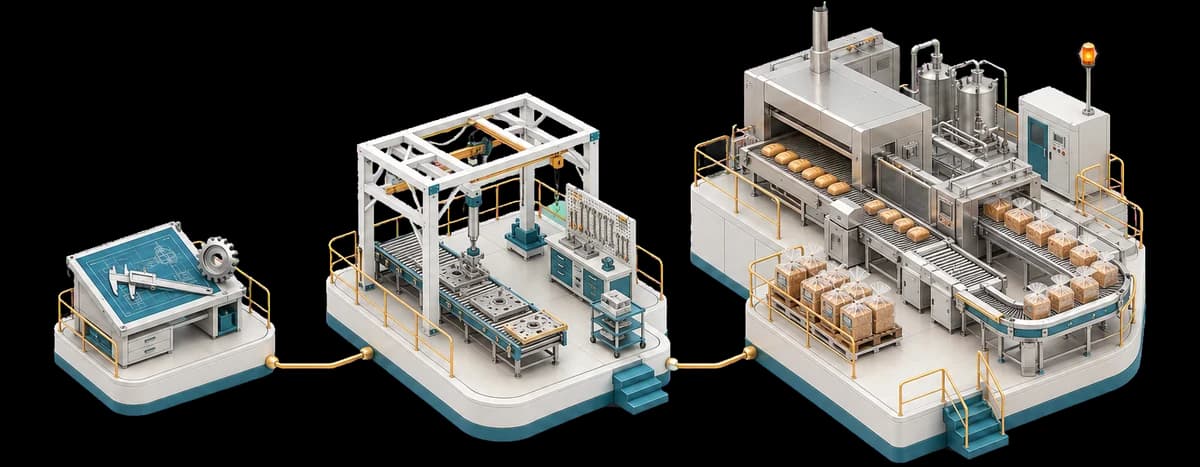
Industrial lines are not off-the-shelf equipment — almost every machine is engineered for your product. That is why detail engineering decides the outcome: checked shop drawings, 3D collision checks, interface reviews and rigorously maintained open-items lists make sure that necessary changes are caught, corrected and followed up early — and flow into execution before anything is fabricated. So as a rule, changes no longer reach the site, and in the end the line delivers the quality your customer expects.

Three process islands side by side: on the left a drafting table with an engineering drawing, in the middle a fabrication hall with gantry crane and workbenches, on the right a running bakery line with oven, packaging and pallets. One line connects all three.
  1. Caught in engineering: Hours
  2. Caught in fabrication: Days to weeks
  3. Caught on the line: Months
The same change at three points in time: what costs hours in engineering costs months on the running line — and a great deal of money.

Frequently asked questions on planning bakery plants

What does planning an industrial bakery cost?
Planning cost depends on scope and degree of automation and is usually considered as a share of the total investment. The decisive math is a different one: through technology selection, avoided change orders, schedules that hold and mistakes caught early, a specialist operational planner typically saves more than he costs. For a reliable figure we need product, volume, site and timeline — a 30-minute conversation is enough for a first assessment.
When does a specialist operational planner beat a general planner?
Whenever the product drives the process — which is the case in every bakery production. A general planner masters building and permits but does not know dough processing, proofing behavior, hygiene zoning and cold chains in detail. Those are the topics that decide how the plant will perform. For pure warehouse or office buildings, a general planner is the right choice.
What is the difference between factory planning and operational planning?
Factory planning covers the whole venture: process, equipment, layout and a process-driven building structure for a new build or an expansion. Operational planning starts from the existing production and looks for the reserves that are already there — bottlenecks, changeover times, material flows, staffing. An existing factory often holds more capacity than it delivers.
How long does planning a bakery production take?
From first analysis to Start of Production, a new build typically takes two to three years, depending on permitting and equipment lead times. An expansion during running production is usually realized in twelve to eighteen months. The concept and master-planning phase itself takes a few months — and decides everything that follows.
Does cbs-concept work internationally?
Yes, we plan worldwide. We know bakery production in more than 65 countries from our own experience and collaboration. Building codes, hygiene regulations, available technologies and local supply chains differ substantially — we account for that from the concept phase on, together with local partners for construction and permitting.
Does cbs-concept also handle construction and permits?
The architectural building and the official permits are not ours to deliver — for those we work with architects and specialist planners. We stay involved until both are in place, and we make sure the building fits the process, not the other way round.

What this looks like in practice — see our services.

To the four service areas

Planning a new production or an expansion?

Let's talk about your project for 30 minutes — no obligation, in full confidence.